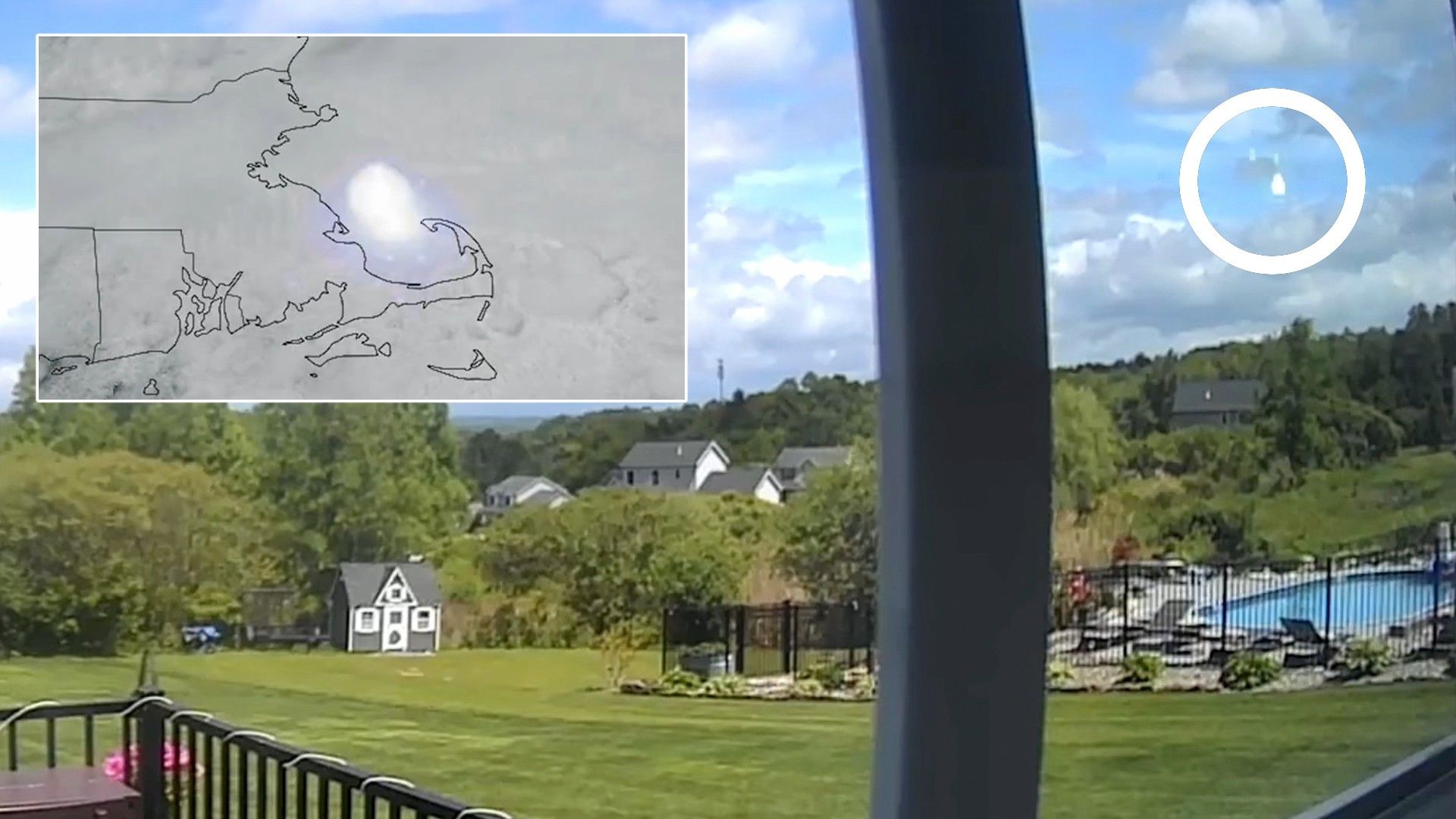
A bright fireball that streaked over coastal Massachusetts in broad daylight in May 2026 has been traced back to a small asteroid whose path was reshaped by Jupiter, according to research reported by Space. A team led by space physicist Juha Vierinen of the Arctic University of Norway in Tromsø combined radar, infrasound and camera records to reconstruct the object's fall and its orbit around the sun. The findings describe a roughly meter-wide body that broke apart over Cape Cod Bay and dropped meteorites into the water.
The event occurred at 1:06 p.m. local time (18:06 UTC) on May 30, 2026. Witnesses across the northeastern United States reported the daytime fireball, and many also heard a sonic boom rumble along the coast. Daytime fireballs of this kind are called bolides.
Why it matters
Meteoroids around a meter in size sit in a poorly observed gap between the tiny grains that produce routine shooting stars and the larger objects that surveys can spot in space, Space reports. Catching one during its fall, with instruments recording both its passage through the atmosphere and the pressure waves it generated, gives scientists a rare chance to tie a specific rock to a specific orbit.
The May 30 bolide was also unusually energetic. Its total impact energy was about 1.1 kilotons of TNT, and only three recorded bolides worldwide had greater impact energy in the year before, according to Space. That combination of rarity and detailed measurement is what makes the case notable.
A radar network in the right place
The key observations came from the Spread Spectrum Interferometric Meteor Observing Network, or SIMONe, based at the Massachusetts Institute of Technology's Haystack Observatory. The project is jointly developed by MIT, the Arctic University of Norway and the Leibniz Institute of Atmospheric Physics in Kühlungsborn, Germany.
"We were fortunate that the event occurred within the coverage of SIMONe," Vierinen told Space.
Ryan Volz, a radio scientist at Haystack Observatory and a member of the team, put the odds in plainer terms. He told Space that a bolide would need to enter the atmosphere within roughly 62 miles (100 kilometers) of a meteor radar system like SIMONe for the head echoes to be detectable, and only a handful of locations in the world currently meet that condition.
A head echo is the radar signature produced when a meteoroid — the rocky body still in space before it becomes a meteor — plunges into the atmosphere and wraps itself in a cloud of plasma as it superheats the air and its own surface. Volz said these echoes provide the tightest constraints on the object's trajectory. The head echo typically lasts only briefly, from about 56 miles (90 kilometers) altitude down to around 44 miles (71 kilometers), where the surrounding plasma becomes dense enough to reflect the radar signal. It then gives way to a trail echo, left behind by a streak of turbulent plasma in the meteoroid's wake.
In this case, the trail echo was picked up at the unusually low altitude of 20 miles (32 kilometers). There the rock fragmented with an explosive force equivalent to 500 tons of TNT. Four Next Generation Weather Radars — operated jointly by the National Weather Service, the Federal Aviation Administration and the U.S. Air Force — then tracked the debris as solid fragments fell as meteorites into Cape Cod Bay.
Pressure waves and citizen sensors
The radar record was reinforced by infrasound detections of the pressure waves created by the object's high-speed descent and breakup. Such waves can travel hundreds or thousands of kilometers. They were recorded by the Elginfield Infrasound Array in Ontario, Canada, and by citizen scientists using Raspberry Shake/Boom pressure sensors, build-your-own micro-barometers made by the Raspberry Pi Foundation.
"Six citizen-operated sensors jointly constrained the arrival direction," Vierinen told Space. "Five other single-station detections and ELFO supplied the signal periods used to estimate the energy release. We are grateful to the citizen scientists whose measurements expanded the coverage and helped locate the event."
From the combined data, the team drew conclusions about the object itself. The meteoroid measured about a meter (roughly three feet) across, and the depth it reached before breaking up suggests it was a fairly solid body, possibly with a high iron content.
"We cannot determine its exact history, but we found no association with any known meteor shower," Vierinen said.
Projecting the trajectory backward into space revealed a long, comet-like orbit around the sun that carried the object almost as far out as Jupiter. Comets on such paths are known as Jupiter-family comets because the gas giant's gravity governs their orbits. This object, however, was not a comet. Earlier research has shown that Jupiter can pull small asteroids out of the main belt between Mars and Jupiter and place them on similar paths.
"Meteoroids can be perturbed by other bodies including Jupiter," team member Marc Fries told Space. He said the meteoroid's aphelion — its farthest point from the sun — lies close to Jupiter's orbit, hinting that a close pass by the gas giant may have redirected it onto its recent Earth-crossing route. The same process, he noted, has gradually thinned the asteroid belt over the solar system's history.
For now, the Cape Cod case stands as a fully characterized fall of a meter-scale object, reconstructed from the ground up. Watch for whether the team's approach — pairing meteor radar with weather radar, infrasound arrays and volunteer sensors — becomes a template for catching similarly small objects before they reach the ground.